ad

Your Ad Here

Welcome To The New TRENDS

Showing posts with label National Assembly. Show all posts

Thursday, July 19, 2012

Lead City University and Others Overcome's at National Assembly


The National University Commission (NUC) has claimed that the seven suspended private institutions will continue operations, but have been banned from admitting new students.
The deputy executive secretary of the commission, Mr Akinbode Agbaoye made the clarification in reaction to a petition filed by Lead City University at the hearing called by House of Representatives on Wednesday.
At the resumed public hearing of the House Committee on Public Petitions, Mr Agbaoye explained that the NUC has cleared two of the suspended universities after they produced the required documents.
He added that the NUC will embark on forensic audit of the remaining institutions on the 19th of July.

Friday, February 18, 2011

Senate prescribes death for terrorists


The Senate yesterday passed into law an anti-terrorism bill which provides that those found guilty of terrorism be sentenced to death. With capital punishment becoming largely unpopular around the world, the punishment prescribed for the crime is likely to generate a lot of controversy, analysts say. President Goodluck Jonathan had on Wednesday sent a letter to the leadership of the National Assembly urging members to pass both the anti-terrorism and money laundering bills. It was the third time the president was writing the assembly over the bills. The version passed by the Senate will be harmonised with that being debated in the House of Representatives and will only become an act of the National Assembly after it has been signed by the president.

Members at the House of Reps are midway into the third reading of the bill and are likely to pass it next week. Considering the interest of the presidency in ensuring a quick passage, a clean copy of the law may be signed by Mr Jonathan before the expiration of the current term.

Currently, Charles Okah, Obi Nwabueze, Edmund Ebiware, and Tiemkemfa Francis Osvwo are facing terrorism charges following the October 1 bomb blasts in Abuja.

Coiled out of 234next.com 

Wednesday, January 19, 2011

National Assembly to Spend N10m on Cleaning Services Monthly’


The National Assembly will this year spend N240.3m on the cleaning of its Phase III building and another N450.7m on fuelling of generators installed in the premises of the same edifice.

The fuel cost will also cover generators in the Phase 11 of the same building and its Annex I & II complex.

The sums are contained in the details of the 2011 national budget, which is awaiting the approval of the 469-member National Assembly.

The new Phase 111 building and its extension serve as office accommodation for the federal lawmakers whose, “jumbo salaries” have elicited public outcry.

If the N240.3m to be spent on ‘cleaning services’ is spread over the 12 calendar months in this year, keeping the building neat will cost tax payers N10.25m monthly.

Similarly, if the N450.7m budgeted for the purchase of fuel is also spread over the same period, keeping Phases 11 and 111 of the new building as well as Annex I&II Complex lit will cost N37.56m every month.

“Fueling of plants for the New Building II and III and annex I and II complex is to cost N450.7m this year,” part of the details of the proposed expenditure reads.

The details of the budget which our correspondent obtained on Tuesday, also show that “engineering maintenance” for the Phase III building will gulp N601m.

The figure is broken down into N330.5m for the Senate and N270.4m for the House of Representatives.

According to the details, orientation courses for senators and members of the House of Representatives who will form the 7th session of the National Assembly will also cost an estimated N450.77m.

The current 6th session, which was inaugurated on June 5, 2007, will come to a close on June 4 this year.

There are 109 senators and 360 members of the House of Representatives.

If the N450.77m is divided by 469, it means that the National Assembly will spend around N962,000 on each lawmaker participating in the orientation courses.

Findings indicate that the orientation programme is meant for new legislators coming to the National Assembly for the first time, but those re-elected (after the April poll) are also expected to participate.

A National Assembly source confided in The PUNCH in Abuja that the orientation courses involved “teaching legislators, especially the new comers, parliamentary etiquette.”

It was learnt that new comers would be taught the right language to use while “addressing the chair or how to observe the rules of the parliament.”

“In moving a motion for example, or walking in front of the mace, there are procedures to be adopted.

“It is essentially about basic things they need to know on how to approach their duties as lawmakers”, the source added.

However, the budget for the orientation courses is separate from the funds budgeted yearly for “training and re-retraining” of legislators for the four years in a tenure.

The Senate budgeted N1.7bn for “consulting and professional services” in 2010, besides a separate expenditure of N58m on “generator fuel.”

Another expenditure of N450m on “maintenance of White House and Annex I & II” was incurred in 2010.

The House of Representatives had a total budget of N2.44bn on “maintenance and general issues” in 2010, in addition to N460.6m it spent on fuelling.

“Fumigation” cost N100m, while another sub-head on “cleaning and gardening” had a provision of N200m in 2010.

Coiled Out of The Punch New Paper.

Thursday, December 16, 2010

NASS JUMBO PAY: Indian Lawmaker must work @ least 49yrs to earn the annual salary of one Nigerian lawmaker


An Indian lawmaker needs to work for at least 49 years to earn the annual salary of a Nigerian senator. A lawmaker in India earns $23,988 (N3.7m) per annum while a Nigerian senator earns $1.2m (N182m) per annum. A monthly breakdown shows that while an Indian lawmaker earns $1,999 (N305, 058) per month, a Nigerian senator earns $ 99,167(N15.18m) per month.


The Indian lawmakers‘ pay is also a far cry from what members of the House of Representatives earn. A federal lawmaker in India will work for at least 34 years to earn the N127m annual salary of a member of the House of Representatives.


In fact, the pay of Indian lawmakers was only increased to the current level in August, after the legislators complained that their earlier monthly pay of $345 (N52, 648) was inadequate.

India and Nigeria are both classified as 3rd world nations and the annoying fact is that the turn out of India is far more than the turn out of Nigeria.


Monday, December 6, 2010

MEGA JUMBO Monthly pay: Senators earn N15.18m each, Reps N10.59m

EACH senator of the Federal Republic of Nigeria earns N15.18m in salaries and allowances monthly, just as each member of the House of Representatives takes home N10.59m a month, investigation has revealed.


For the Senate, each senator (excluding the Senate President and his deputy) takes home about N198.54m annually (N16.64m per month). This translates into a total of N21.243bn.


The amount includes each senator‘s N45m quarterly allowance, which amount to N180m annually for the four quarters of the year, and the official N18.54m that goes into their individual accounts annually as salaries and other emoluments.


To keep the federal lawmakers in office for one year, the Federal Government spends a staggering N67.32bn on their salaries and other allowances.


There are 469 federal lawmakers, comprising 109 senators and 360 members of the House of Representatives.


The figure, however, excludes the lawmakers‘ constituency votes, which are not paid directly to them.


This implies that at N127.18m per member (excluding the Speaker and his deputy), N45.466bn is being expended as wage bill annually on 358 legislators in the House of Representatives.


According to available statistics, the Speaker takes home N117.20m annually (N9.76m per month), while his deputy gets about N116.80m annually (N9.73m per month). The seemingly lower pay for the leadership of the House is explained by the fact that the officers are entitled to full provision of some items that had been monetised for other members.


When the wage bill of these principal officers of the lower chamber is added to the total take-home (N45.466bn) of the other 358 members, the total wage bill of the entire House of Representatives adds up to N45.699bn.


Further analyses of the RMAFC document revealed that the Senate President gets N188.94m annually (N15.74 per month), while his deputy takes home N188.31m annually (N15.69m per month) as salaries and allowances.


When the wage bill of the Senate President and that of his deputy is added to what the other 107 senators earn, the total take-home for the entire Senate becomes N21.621bn.


But some of the legislators have insisted that the quarterly allowances are for running their offices and so, should not be included in their take-home.


However, there are other earnings not captured in the above figure because they are not fixed.

For instance, each senator is entitled to a severance package of N6,079,200 upon successful completion of a term; duty tour allowance of N23,000 per night when they travel within the country and estacode of $800 per night when they travel out of the country. Should they desire, they are also entitled to a car loan of N8,105,600 each. This is, however, refundable.

Each member of the House of Representatives is also entitled to a severance package of N5,955,637.50 upon successful completion of tenure; refundable vehicle loan of N7,940,850; N21,000 duty tour allowance per night when they travel within the country and $550 estacode per night when they travel outside the country.


However, senators who obtained car loans at the beginning of the legislative session had, through the President of the Senate, Mr. David Mark, reportedly made an official request that the loans be converted to grants since they were not told at the onset that the money would be repaid.


The earnings of legislators and other political office holders had been controversial, especially in recent times. The controversy reached its high point when the Governor of the Central Bank of Nigeria, Mr. Lamido Sanusi, alleged that 25 per cent of Nigeria‘s annual total overhead cost was spent on lawmakers.


The worry of Nigerians, however, has not been about the official earnings, as the legislators are constantly accused of appropriating huge amount of money to themselves as constituency project funds on a quarterly basis.


It is alleged that these funds, which run into billions of naira, end up in the pockets of legislators as the constituency projects are hardly executed and the exact amounts of money collected are hardly known. 


The Federal Government has yet to implement the reduced emoluments of political office holders and judges recommended 18 months ago by the RMAFC.


The commission had forwarded a bill, titled, ”Certain Political, Public and Judicial Office Holders (Salaries and Allowances etc) (Amendment) Act, 2008,” to the National Assembly through the Federal Executive Council to legislate upon.

If the bill had been passed and implemented, the official emolument of a senator would have reduced to N12,209,060 per annum, while that of a House of Representatives member would have been N10,273,474 annually.

For more information CLICK HERE . 
coiled out of The Punch. (www.punchng.com)

Thursday, December 2, 2010

Sanusi stands by comments and refuses to apologize on National Assembly spendings

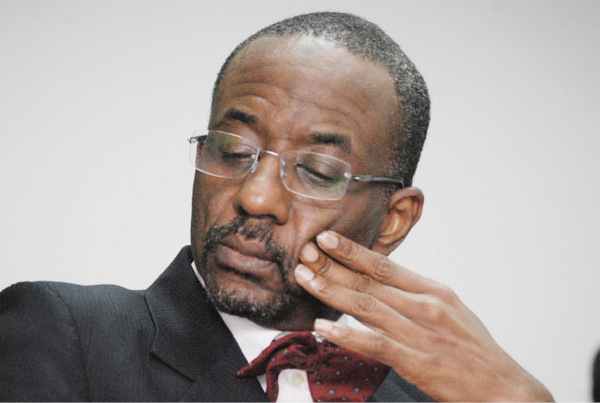
Sanusi Lamido Sanusi (CBN Governor)
I always tell people that one day Nigerian's would wake up to fight for their rights. Am so happy to be posting this because the CBN governor has just done that to the so called Lawmakers of Nigeria. Drop a comment about what you think.............

Despite brutal questioning by a Senate select committee, Central Bank governor, Sanusi Lamido Sanusi, yesterday stood by his comments that the National Assembly’s budget for overhead is 25.4% of the nation’s total.


Mr Sanusi withstood strong attempts to browbeat him into admitting that the figures were at least lower than that, or that he was misquoted by the media.

The public hearing convened by the Senate followed newspaper publications quoting the Central Bank governor as saying that the nation spends one-quarter of its funds on running the National Assembly, and a subsequent publication quoting the finance minster as saying he would cut the budgetary allocation to the assembly.

Mr Sanusi had at a lecture delivered at the eighth convocation of the Igbinedion University , Okada, Edo State, said 25% of the nation’s resources are spent on the lawmakers. This annoyed the Senators who ordered him to appear before them and defend his statement.

The Central Bank governor appeared on Wednesday before the Senate committee alongside the finance minister, Olusegun Aganga. However, unlike the finance minister who quickly dissociated himself from the statement that he intended cutting allocation to the assembly, Mr. Sanusi admitted saying that 25.4% of the nation’s overhead cost is spent on the National Assembly.

He held his grounds, backing his statements with records from other national dailies which quoted him correctly, and with statistics from the budget office.

Mr. Aganga who later assumed the role of an umpire told the Senators that the CBN governor’s figures were correct although they may appear wrong in another context.

The minister argued that overhead cost figures which include Service Wide Votes (money spent on maintenance of government facilities), are as legitimate those which do not include the votes.

Rage

Evidently angry, Iyiola Omisore (PDP Osun State) who led the Senate panel alleged that the CBN governor had chosen to deliberately incite Nigerians against the Assembly. He asked Mr. Aganga to state categorically whether Mr. Sanusi’s statement was right or wrong. The minister again said the statement depends on context or the way one chooses to use statistics.

Members of the Senate panel made up of four different committees could not hold back their rage against the unyielding CBN governor and frequently compared him to the more amenable finance minister, trying to coax him into some form of apology.

The Senators made no effort to hide their bias and blatantly refused to give any room to the Central Bank governor, to defend his figures and the context in which they were used.

Mr. Omisore pointedly told the harassed CBN governor at one point that the committee was not prepared to listen to him and that he must direct his responses through the finance minister. Mr Sanusi, however, occasionally barged in to make the point that his figures were right and that he got them from the director of budget’s office.

No apology

He said he would only apologise if the figures from the budget office were wrong. He insisted that, “Total Federal Government Overhead is over N500 billion and the Overhead of the National Assembly is N136.2 billion. This is exactly 25.1 per cent of total government overhead. I am quoting from the figure I got from the Budget Office. If you like, you can invite the Director-General of the Budget Office.’’ When told by Mr. Omisore, who is the Chairman, Senate Committee on Appropriation, that the figure was wrong following a clarification by the Minister of Finance, Mr. Sanusi replied: “I don’t know where the minister got his figures.” 

To the calls on him to apologies, he said, “By my nature, if I do not believe that I am wrong, I do not apologize.” He urged the Senators to examine the context under which he made his statement which was actually in a lecture about factors that fuel inflationary trends.

Staking his job

After hours of fruitless attempts to get the CBN governor to admit wrongdoing and apologize to the Senators, the lawmakers seemed to deviate from the matter and begin to question the character of the governor and the annual budget of the CBN.
“We really need to be sure that the CBN governor has the character to stay in that office,” Heineken Lokpobiri (PDP Bayelsa State) said.

Other Senators took turns to tongue lash the CBN governor. They accused him of speaking too much and asked him questions like “do you enjoy your job? Do you feel like quitting?’’ And if he thinks democracy is too expensive.

“My name is Sanusi Lamido Sanusi, (my name is) not Central Bank Governor. I enjoy my job but if you want me to quit, I will honorably quit,” Mr Sanusi replied before a cheering crowd of spectators.

The unwavering Central Bank governor told the Senators that the survival of democracy is dependent on allowing people the freedom to speak. He added that he had always been involved in the fight for democracy way back to the time of June 12 and that even if the military takes over now, he will still fight them off.

The issue remained unresolved as both sides disagreed with each other’s figures. However, Mr. Omisore gave the CBN governor a stern warning not to use such figures in comments about the National Assembly anymore.

Mr. Sanusi is also expected to appear before the entire House of Representatives today to defend his statement.
pub-3118166399990413